cforge C build system tooling + safe_c.h
Introduction
I've been building a modern C build tooling called cforge where it solves a lot of the issues in the C ecosystem. There has been requests for me to explain its main functionalities and how it helps eliminate one of the pain points of developing in C: its build tooling system, while they are functional and varied, are fragmented and difficult to use.
Moreover I then combined cforge with safe_c.h --> it gave birth to a wholly different user experience when writing C. It is very powerful, so much that I can't go back to use vanilla C. You know that thing once you found out about something and you can never go back? Some examples:
- IPS screen vs CRT.
- SSD vs HDD.
- Android phones vs old Nokia phones.
- cforge+safe_c.h vs vanilla C.
While I understand there might be issues with portability, I can never write vanilla C again and in this post I'll show you why.
One caveat though: I live in two worlds: finance and programming so I have a fairly busy schedule. I struggle to find the time to write this and it has been postponed since a month ago, hence I made the difficult decision to let AI produce an overview of cforge+safe_c.h
Below is an AI generated overview of the features and capabilities of cforge and safe_c.h
Comprehensive Analysis: cforge + safe_c.h Contribution to the C Ecosystem
1. The Problem Space: Why C Needs This
The "C Safety Gap"
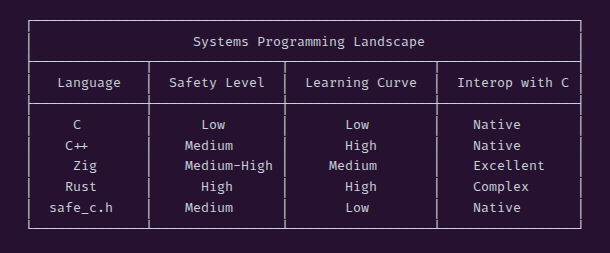
The Gap: There was no solution for C programmers who wanted:
- Memory safety aids without switching languages
- Modern abstractions (vectors, optionals, results) without C++ complexity
- Compile-time code generation without template metaprogramming
- Production-grade hardening without manual flag management
────────────────────────────────────────────────────────────────────────────────
2. Technical Innovations
A. Build System Innovation: "Safety-First Compilation"
cforge introduces a staged compilation philosophy unique in the C ecosystem:
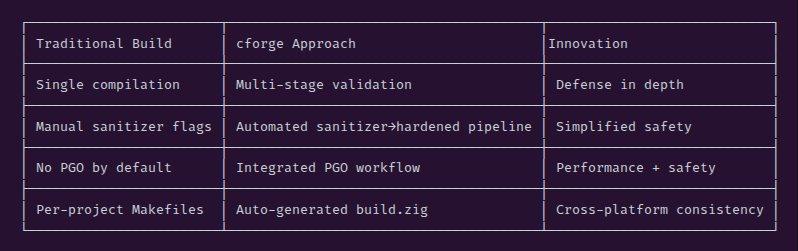
Key Insight: cforge treats compilation as a verification pipeline, not just a translation step.
  # Traditional: Just compile
  gcc -o app main.c

  # cforge: Validate then compile
  Stage 1: fanalyzer (static analysis)
  Stage 2: ASan/UBSan (runtime verification)
  Stage 3: clang-tidy (code quality)
  Stage 4: Hardened release (production)
B. Comprehensive Test Suite ~ criterion-lite
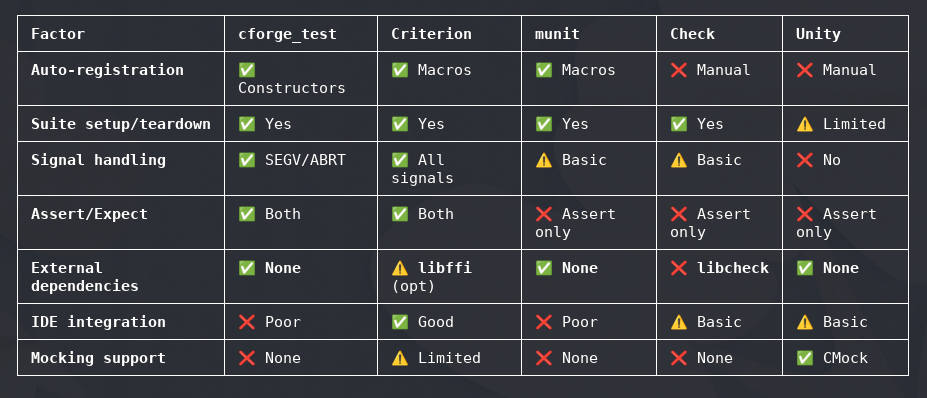
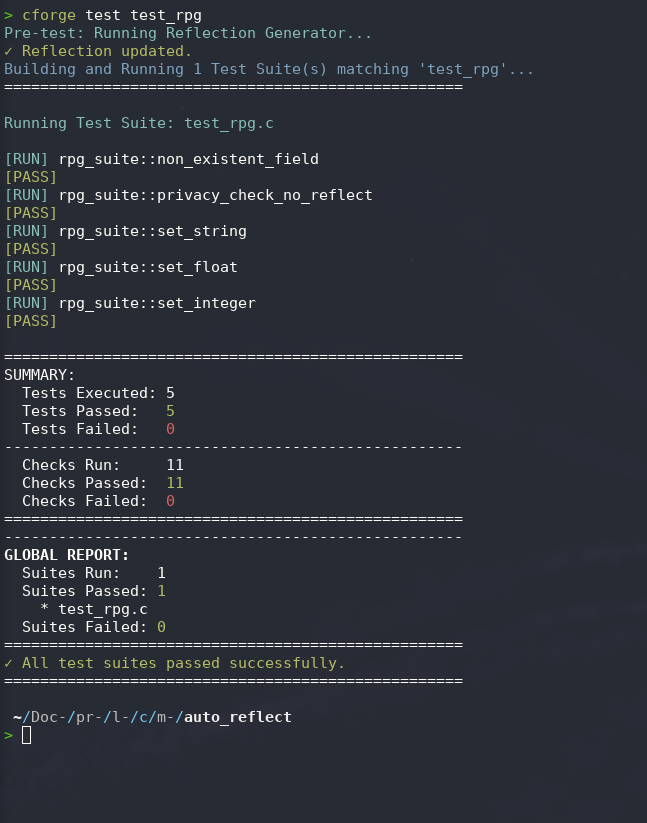
The cforge test suite excels through zero-configuration auto-registration (constructor-based), crash resilience (signal handlers for segfaults), and a two-tier assertion model (fatal/non-fatal)—all within a single dependency-free header. Its tight integration with the cforge build pipeline automatically runs tests under AddressSanitizer, providing memory safety validation without extra setup, making it ideal for teams wanting modern testing ergonomics without leaving the C ecosystem.
C. safe_c.h: The "Modern C Standard Library"
1. RAII Without Language Changes
Using GCC/Clang cleanup attribute (now C23 [[cleanup]]):
  // Before: Manual cleanup, error-prone
  FILE* f = fopen("data.txt", "r");
  if (!f) return -1;
  // ... 50 lines later, forgot fclose() or return path missed it

  // After: Automatic cleanup
  AUTO_FILE(f, "data.txt", "r");  // fclose() guaranteed
Contribution: Brings deterministic resource management to C without requiring C++ destructors or Rust ownership.
2. Type-Safe Generics via Macros
  // Generates complete type-safe vector implementation
  DEFINE_VECTOR_TYPE(Player, struct Player)

  PlayerVector team;
  player_vector_push_back(&team, (Player){.health = 100});
  // Type-safe: compiler enforces Player type
Contribution: Proves that C macros can provide generics-like functionality with better error messages than C++ templates (no SFINAE madness).
3. Error Handling as Values
  DEFINE_RESULT_TYPE(Int, i32, const char*)

  ResultInt divide(i32 a, i32 b) {
      if (b == 0) return RESULT_ERROR(Int, "Division by zero");
      return RESULT_OK(Int, a / b);
  }

  // Explicit error handling - no exceptions
  ResultInt r = divide(10, 0);
  TRY(r);  // Early return on error
Contribution: Rust-style error handling in C without language changes or exception overhead.
4. Zero-Cost Smart Pointers
  UniquePtr ptr = UNIQUE_PTR_INIT(malloc(100), free);
  void* data = unique_ptr_get(&ptr);
  // ...
  // Automatic cleanup at scope end
Contribution: Proves RAII patterns can work in C without vtables or runtime overhead.
D. Reflection Infrastructure
The annotation system is novel for C:
  typedef struct REFLECTED {
      JSON_KEY("player_id")  // Metadata for code generator
      i32 id;

      VALID_RANGE(0, 100)    // Validation constraints
      f32 health;
  } Player;
Contribution: Demonstrates that C can have modern reflection through:
- Source annotations (clang attributes)
- External parsing (Python + libclang)
- Code generation
This bridges the gap between C's compile-time simplicity and modern introspection needs.
────────────────────────────────────────────────────────────────────────────────
3. Ecosystem Contributions
A. The "Progressive Enhancement" Model
Unlike Rust or Zig which require rewriting, cforge enables incremental adoption:
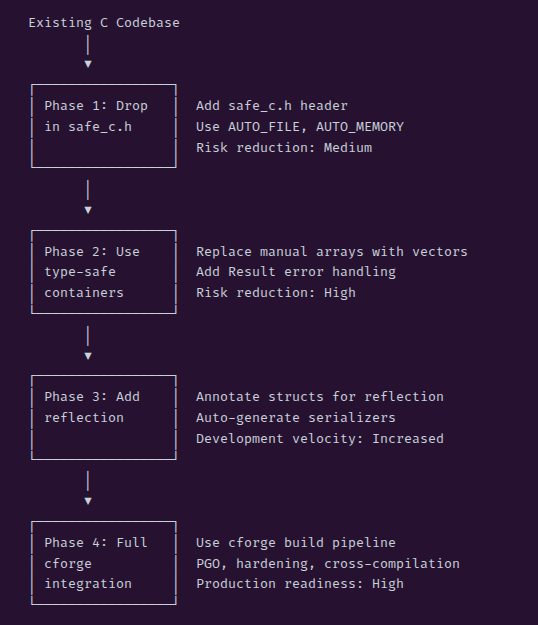
Impact: Lowers barrier to entry for safety improvements—no rewrite required.
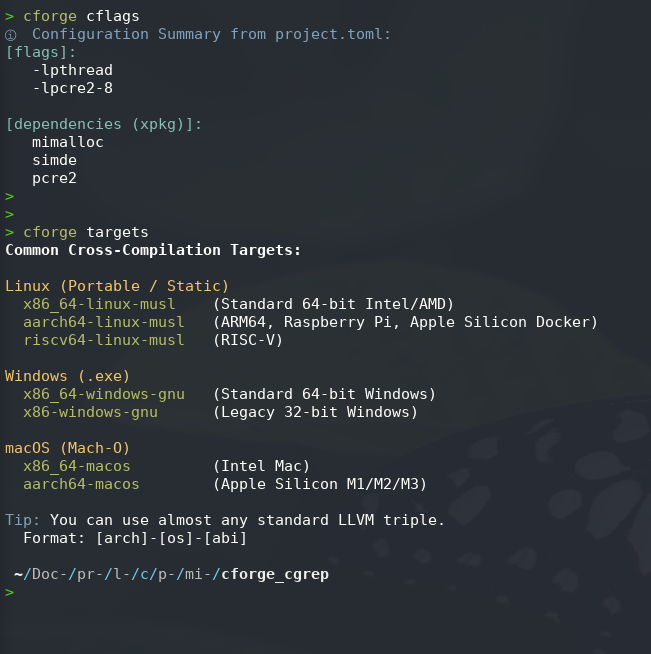
B. Cross-Compilation Simplified
cforge's use of Zig as a cross-compiler backend:
  cforge target aarch64-linux-musl
  # Automatically handles:
  # - Toolchain acquisition
  # - Flag translation (removes -march=native for cross)
  # - Static linking configuration
Contribution: Makes cross-compilation accessible to C developers who would otherwise struggle with complex toolchain setup.
C. Education Value
safe_c.h serves as a reference implementation for:
- How to implement RAII in C
- Macro-based generic programming patterns
- C23 attribute usage
- Safe C coding practices
Impact: Educational resource for C developers wanting to modernize their skills.
────────────────────────────────────────────────────────────────────────────────
4. Comparative Positioning
vs. C++ (The "Upgrade Path")
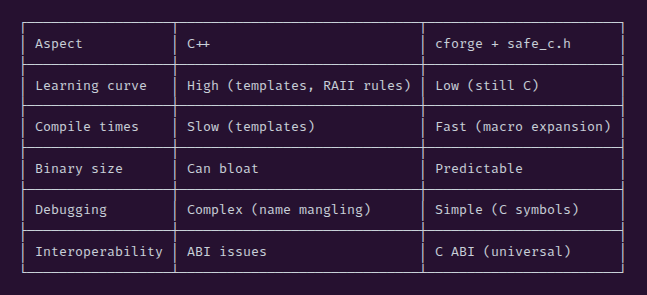
cforge's niche: "I want C++ features but in C."
vs. Rust (The "Safety Rewrite")
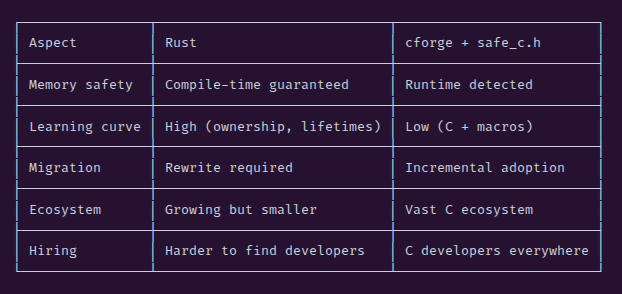
cforge's niche: "I need safety improvements but I don't want to rewrite. Rewrites are waste of time."
vs. Zig (The "C Alternative")
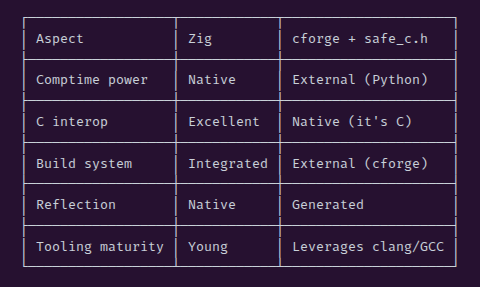
cforge's niche: "I want Zig's safety but in C."
────────────────────────────────────────────────────────────────────────────────
5. Unique Value Propositions
1. The "Zero-Rewrite" Safety Upgrade
Unlike Rust or Zig, cforge allows teams to improve safety without rewriting a single line of legacy code. Just include the header and start using AUTO_FILE for new code.
2. Production-Hardening Automation
The combination of sanitizer→hardening pipeline is unique:
  # One command gets you:
  # - AddressSanitizer (development)
  # - Stack canaries (production)
  # - Control-flow integrity (production)
  # - PGO optimization (production)
  cforge pgo main.c
3. C as a "Safe Assembly"
safe_c.h demonstrates that C can be used as a portable assembly with safety guardrails, challenging the narrative that C is inherently unsafe.
4. Reflection Without Runtime Cost
The annotation→generation approach proves you can have:
- JSON serialization
- Schema versioning
- Binary formats
- All at zero runtime overhead (generated C code is plain C)
────────────────────────────────────────────────────────────────────────────────
6. Limitations and Trade-offs
A. Fundamental Limitations
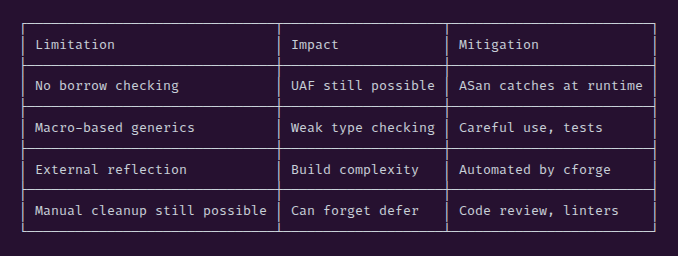
B. When NOT to Use cforge
- Kernel/embedded with no stdlib: safe_c.h needs malloc/free
- Certified safety-critical (SIL 4/ASIL D): Needs formal verification, not just sanitizers
C. The "Two-Step Build" Problem
  cforge reflect  # Generate code
  cforge build    # Compile
This is more complex than single-step compilation, though cforge automates it.
────────────────────────────────────────────────────────────────────────────────
7. Impact on C Ecosystem
A. Influencing C Standards
safe_c.h demonstrates demand for:
- [[cleanup]] attribute (now in C23)
- Better bounds-checking standard functions
- Optional types in standard C
B. Bridging C and Modern Languages
cforge shows a migration path:
- Start with C + safe_c.h
- Add reflection annotations
- Generate bindings for other languages
- Gradually replace modules with Rust/Zig
C. Tooling Elevation
By integrating:
- clang static analyzer
- AddressSanitizer
- clang-tidy
- Profile-guided optimization
cforge raises the bar for what C build tools should provide.
────────────────────────────────────────────────────────────────────────────────
8. Future Implications
The "Annotated C" Pattern
The REFLECTED, JSON_KEY, VALID_RANGE annotations suggest a future where:
- C code carries semantic metadata
- External tools generate bindings, validators, documentation
- The "single source of truth" problem is solved
Build System Convergence
cforge's use of Zig for cross-compilation suggests a trend:
- C compilers focus on compilation
- Build orchestration handled by modern tools (Zig, cforge)
- Package management integrated (cforge pkg)
────────────────────────────────────────────────────────────────────────────────
Conclusion
cforge + safe_c.h contributes the "missing link" in systems programming: a way to write safer C without leaving C.
Its key contributions are:
- Proving C can be safe-ish with the right tooling
- Lowering the barrier to safety (no rewrites required)
- Demonstrating annotation-driven development for C
- Automating production hardening (PGO, sanitizers, hardening flags)
- Providing a migration path from C to safer languages
For the C ecosystem, this means:
- Existing C codebases have a viable modernization path
- New projects have an alternative to "C or rewrite" dichotomy
- The C tooling ecosystem gets a reference for what modern C development should look like
The ultimate contribution: Showing that C's obsolescence is not inevitable—with the right headers and build tools, C can remain viable for new development while teams gradually migrate to Zig or Rust.
cforge with safe_c.h represents a novel "progressive enhancement" approach to modernizing C—delivering C++17/Rust-like safety and ergonomics without abandoning C's core philosophy or requiring language changes. It fills a critical gap in the C ecosystem: how to write safer C without learning a new language or accepting runtime overhead.
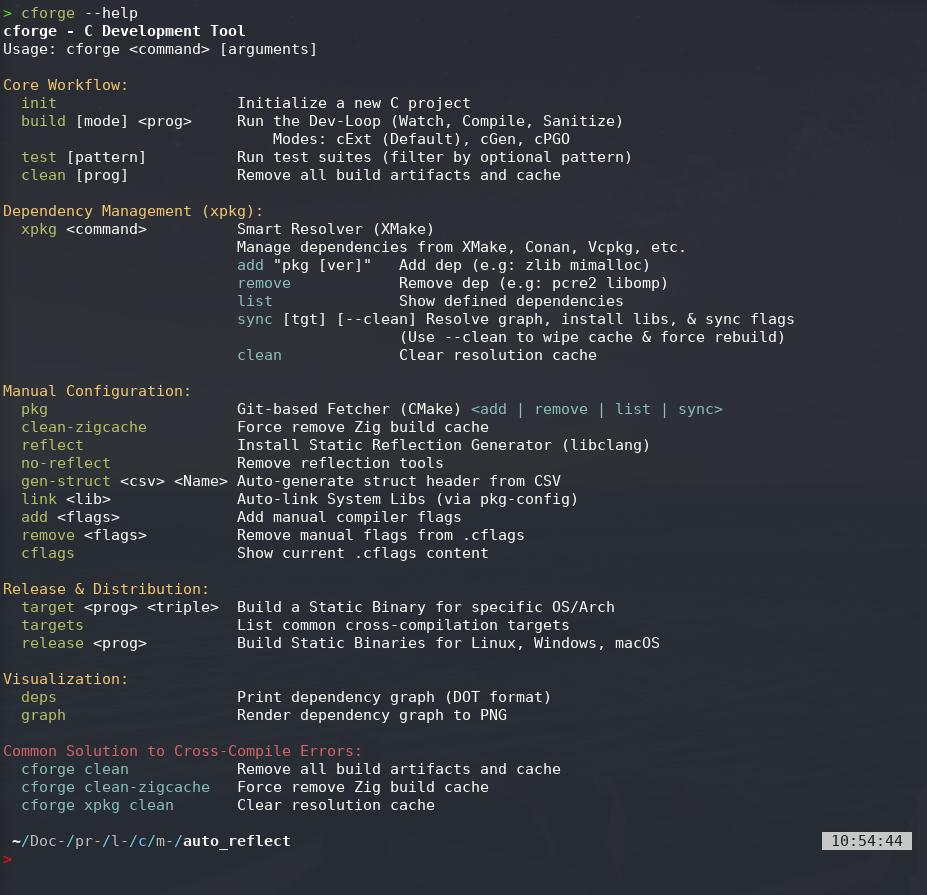
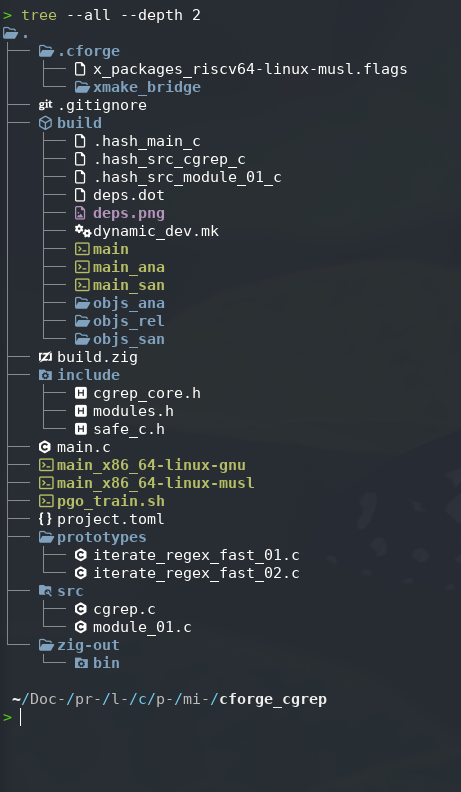
Some screenshots of cforge:
Addendum
How does this cforge+safe_c.h combo affect my programming?
- I fear that I no longer want or willing to write vanilla C using existing build tools (unless its a requirement).
- Write less and less of Zig and Rust.
- There might be still a chance for Zig though if they've sorted out their async and released the 1.0 stable version. Breaking changes is a hassle I don't want nor have the time to deal with.
- In the mean time I'm having an absolute blast writing C in cforge+safe_c.h, so much that it diminishes the value of Zig and Rust in my eyes. Don't get me wrong, they're are still great languages!
- Imagine using Cargo in Rust or uv in Python or crosscompiling to multiple targets in Zig: that's the user experience of using cforge.
I'm currently using cforge+safe_c.h for a monsoonsim-lite project ~ a CLI-based business simulator. Another question I get asked frequently: will I open source the code for cforge and safe_c.h ? I'm not sure, most of the programs I've built are for internal use either me personally or office related work.
I actually don't want a "maintainer's life" as the creator of Zen-C is currently having. As mentioned earlier: I live in 2 worlds (finance and programming). I built something, it works for me and that's it. If there's a bug I'll fix it, if there's additional features that I need, I'll make the features.
The key: it revolves around to what I need and my use case, I'm not interested to what others need. So yeah it's the opposite mindset of a maintainer. Why do I have this mindset? Coz I've burned out before trying to fulfill other people's requests and I don't want to repeat that. Sorry for the rant...cheers!
Comments section here
If you enjoyed this post, click the little up arrow chevron on the bottom left of the page to help it rank in Bear's Discovery feed and if you got any questions or anything, please use the comments section.